Opening a Sole Trader in Ireland
Find here how to register as a sole trader in Ireland. For details about company registration you can contact our agents in Ireland.

Foreign entrepreneurs can start a business in Ireland by incorporating various legal entities or as self-employed individuals. Natural persons can operate as sole traders, which is a basic business form with no legal personality.
Before registering as a sole trader it is best to verify with experts in company formation in Ireland what all the requirements are.
The Irish sole trader from a legal perspective
Choosing the legal form of your future business is very important when setting up a company in Ireland, especially from a liability point of view. Considering that the sole proprietor does not take a corporate form, the owner’s liability business’ debts and obligations are unlimited, in comparison to limited liability companies.
| Quick Facts | |
|---|---|
| Applicable law | Registration of Business Names Act 1963 (sole traders are not governed by the Companies Act) and the Taxes Consolidation Act 1997. |
Special requirements related to the name (YES/NO) | Yes, when operating under a different name than the owner’s, the trading name must be registered with the Companies Registration Office. |
Legal personality (YES/NO) | No, the sole proprietorship does not have a legal personality. |
| Activities permitted | Activities that enable a person to work as self-employed (doctor, dentist, architect, etc.). |
| Registration availability for foreigners (YES/NO) | Yes, foreign citizens can also set up sole proprietorships in Ireland. |
| Special requirements for foreign citizens (if any) | Non-EEA nationals need an immigration permission allowing self-employment (e.g. Stamp 4 or business permission); EEA nationals do not. |
| Authorization requirements (if any) | Depends on the activity to be carried out. |
| Local address required (YES/NO) | Yes. |
| Authority to be registered with | The Revenue Commissioners and, where a business name is used, the Companies Registration Office as mentioned above. |
| Tax registration required (YES/NO) | Yes, the sole trader will be issued a Tax Reference Number. |
| VAT registration requirement (YES/NO) | Only when reaching the minimum registration threshold. |
| Social security registration requirement (YES/NO) | Yes. |
| Taxation of sole traders in Ireland | The income tax under the self-assessment system. |
| Applicable income tax rate | Income tax at 20% (up to EUR 44,000 for a single person in 2026) and 40% above; USC of 0.5%–8% (8% above EUR 70,044), plus a 3% USC surcharge on self-employment income above EUR 100,000; Class S PRSI of 4.35% (from 1 October 2026). |
| Support in setting up a sole trader in Ireland (YES/NO) | Yes, our Irish company formation agents can help you create a sole trader. |
How do you know if the sole proprietorship is the right business type for you? Here are a few aspects that can help you clarify things:
- you can use this legal form when you plan to establish a small company;
- you have a specific profession (doctor, dentist, architect) that allows you to work on your own;
- you work based on projects, which is the case for many social media managers and even digital marketers.
If you want to establish an Irish sole trader, here are some advantages to make you choose this legal form:
- it takes a few days to register as a sole proprietor in Ireland;
- you do not need to deposit a minimum share capital, but you must open a local bank account;
- you must also register for taxation purposes, and eventually apply for a VAT number if your turnover reaches the minimum registration threshold (EUR 42,500 for services, EUR 85,000 for goods);
- it is also possible to have employees if you consider it necessary.
If you need more information about this business form, our Irish company formation agents can advise you whether it is suitable or not for you.
Registration as a sole trader in Ireland
Unlike registering a company in Ireland, the self-employed individual can complete an activity by using his/her name. Therefore the first step towards becoming a sole trader is to register the trading name with the Irish Companies Registration Office (CRO) by submitting Form RBN1. The procedure can also be completed online. The Certificate Business Name issued by the CRO must be displayed at the business location.
It is also advisable to open a business account with an Irish bank.
For help with the name registration process, you can rely on our experts in Ireland.
Sole trader registration requirements for foreign citizens
Ireland is one of the most sought-after countries when it comes to foreigners seeking to move to an English-speaking country. If you are planning to take such a step and open a company in Ireland as a sole trader, you must obtain a residence permit if you are a non-EU citizen relocating to the European Union for the first time. In addition, you can apply under the Start-up Entrepreneur Programme (the Immigrant Investor Programme closed to new applications on 15 February 2023) that enable you to immigrate with your family.
If you come from an EU state, this formality is no longer required, and you can skip directly to registering your business name (if not trading under your own name) with the Companies Registration Office.
Our company registration consultants in Ireland are at your disposal if you want to apply for one of the above-mentioned immigration programs.
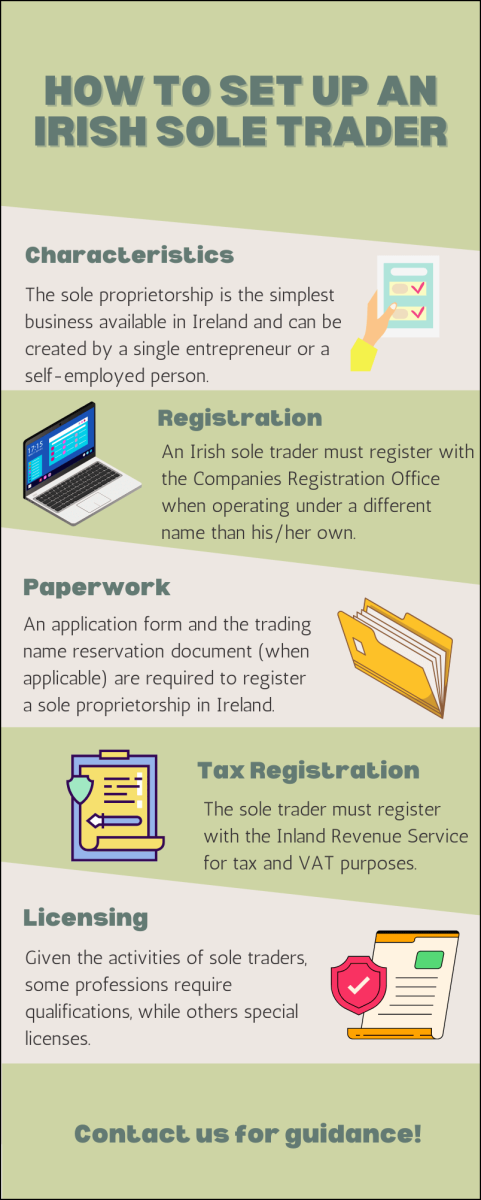
Please find below our infographic on this type of entity:
Tax registration for Irish sole traders
The second step towards becoming self-employed in Ireland is to register for taxation purposes. Registration must be done with the Revenue Commissioners. In order to do that one must file the TR1 Form which can also be used to register for the value added tax (VAT). Once the application is processed the sole trader will receive a notice of confirmation.
The Irish sole trader must also pay a Class S PRSI (Pay Related Social Insurance) contribution. The taxes paid by Irish sole traders fall under the self-assessment system and they are required to maintain all records on purchases and goods, received and spent amounts in order to fill out their annual tax returns. However, Irish sole traders may also be eligible for certain fiscal deductions (the Start-up Refunds for Entrepreneurs (SURE) scheme applies only to individuals investing in shares of a new company, not to sole traders).
Here is also our video on this subject:

The Irish employment market
Considering Irish sole traders are self-employed individuals, they can enter the ranks of the national workforce. According to CSO statistics from 2023 (by Q2 2026, 2,839,300 people were in employment):
- in the second quarter (Q2) of 2023, the Irish workforce comprised 2,643,000 persons;
- in the same period, the number of employees rose by 94,100 compared to the same quarter of 2022;
- the number of self-employed individuals dropped by 5,500 to 335,400 during the same Q2.
For information about the advantages of being a sole trader, you can contact our specialists in company incorporation in Ireland.
Bernhard Correa, Financial Consultant LSC & PARTNERS · 2 October 2026Bernhard Correa is a corporate and operational manager with LSC & Partners.